The launch was promoted to the French and Spanish markets through a press campaign in Spain and France, communicating the added value of this new system and the brand values. Target audience: architects, installers, developers.
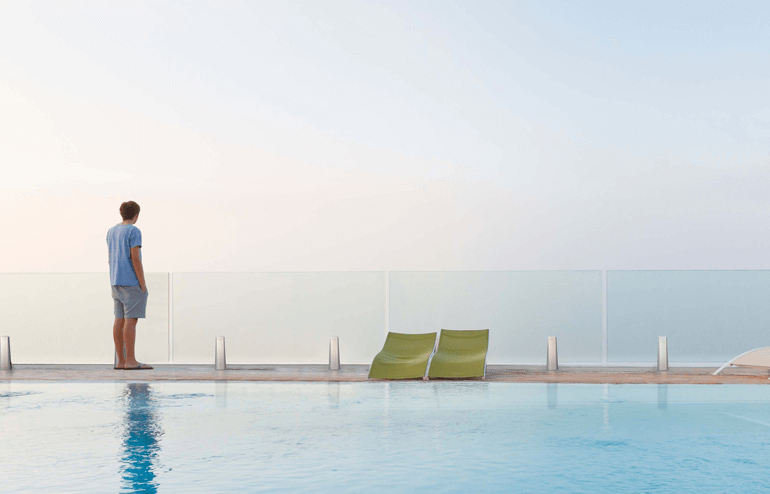
Comenza, a Spanish brand specialising in the development of industrialised guardrail and handrail systems, presents the GlassFit CC-800 system in Duplex 2205 stainless steel, particularly suitable for systems installed in swimming pool environments.
KLEIN introduces the first fully standardised lightweight mobile partitioning system made of oak wood: NATURE by KLEIN. A real innovation for the interior design sector.
We communicated the launch through a press plan with the professional, specialized, Spanish and French media, as well as through the writing and communication of case studies, the realization of an e-mail marketing campaign in 4 languages, an advertising campaign on social networks and the development of a dedicated multilingual homepage. To find out more about NATURE, visit the website: https://www.klein-europe.com/nature/?lang=en
It’s indisputable! The COVID-19 pandemic has caused many changes, and more are yet to come. Overcoming distance and understanding your clients’ new needs, maintaining fluid and frequent contact with them, providing them with answers and alternatives, and enhancing brand visibility have all become key to companies’ survival.
In the B2B world, digitalization used to be an area of opportunity; now, it is a top priority.
Reflection, analysis, and ambition
Let’s take a moment to reflect on your resources and processes in order to design marketing and communication actions that will improve your business efficiency. B2B marketing requires a deep understanding of business processes. Who is the specifier for your product or service? Where can you find them and how do you pique their interest? What means of communication do your competitors use? Verifying this will allow you to identify communication channels that may be relevant to your brand and assess how important they may be to your strategy.
In this moment of stagnation in the national market, it’s time to diversify. You know that your product is relevant and interesting for other markets, but how can you communicate this to them? Your brand already has a certain level of international presence, but are there sectoral means of communication, professional portals, or online events through which you can gain notoriety and generate B2B leads? Several industry-specific B2B platforms allow you to present your products or projects and automatically collect leads. This can be particularly interesting in export markets, where your sales team is not as established and your brand needs to gain notoriety.
ZEKLUU has experience in a wide range of European markets, with specific expertise in the French market. We can help you with your international development process: contact us.
Let’s review the basics…and stop being so timid!
More than ever, visibility is crucial for your brand’s success. In times of limited travel and social distancing, let’s celebrate the fact that you already have a certain digital presence and then build on that. How can you do that? Well, to start, you can rethink your strategy on channels where you don’t depend on anyone else: your website, social media, database…
Get the most out of your website: it’s your main showcase. It should be functional, accessible, informative, and inspiring, but more than anything, it should be designed to attract high-quality traffic, instill trust, and generate business contacts. Do your potential clients see your website? Are you getting traffic? Let’s analyze this. If not, how can you increase traffic? Is your website designed to collect data? Do you download and efficiently manage the leads it provides? What could you do to collect more leads and manage them more efficiently? If you think that this discussion could be valuable to you, let’s have it together.
What are the keywords your potential clients use? You may or may not know what these are, or you may not be using them optimally, which in turn limits traffic to your website. In the B2B world, a quality keyword analysis is probably one of the most cost-effective actions you can take, which simultaneously having a high return on investment, if used to optimize your web architecture and create a solid SEO strategy. If you haven’t done this yet, or if you did it a long time ago, we can help.
Social media: which one to choose? Just one? All of them? Are you on the networks that are truly of interest to you? Can you concentrate your resources to create a bigger impact? Can you produce valuable content and synergies with your website? Social media can be a showcase capable of generating business, but it can also consume many more resources than it provides. You have to define a strategy, thinking in the medium-term.
Databases and e-mail marketing: you surely have a large number of contacts that have been collected by your sales team at trade fairs or events, or which have come in from the contact form on your website. Unfortunately, a list of contacts isn’t a database if you aren’t using it properly. Do you use e-mailing as a communication strategy? Do you keep your contacts informed of relevant updates? Do you comply with GDPR? Have you designed a strategy that allows you to generate interest and then keep people interested, with the ultimate goal of informing, selling, creating loyalty…? If you would like to know more about this topic, contact us here.
In conclusion, for B2B companies, digitalization used to be an area of opportunity; now, it is a top priority. You don’t always have to change everything to improve your efficiency, but it is always fundamental that you understand your strengths and weaknesses so that you can establish a plan of action that will leverage the former while minimizing the latter.
Unveiled in
1932, this masterpiece symbolizes the perfect understanding between an
architect and his clients. Robert Mallet-Stevens, an innovative architect,
lover of straight lines and conceptual simplicity, was hired by the Cavrois, a
bourgeois couple from northern France who had heard about the architect’s
previous work and who had a very clear and avant-garde vision of the home they
wished to build.
Surrounded by a
200,000-square-foot garden with a modern pond, the chateau that the
Cavrois dreamed of had a stark facade measuring 200 linear feet, plus 30,000
square feet of livable space. Its large windows and numerous terraces, along
with a multitude of bright, ample interior spaces, were quite unconventional
for that time in history. Natural materials, such as wood and marble, very
advanced technologies for the era (central heating, telephones, elevators,
etc.), and an absolutely functional layout continue to lend a heavy dose of
modernity to its light-filled interior spaces. Robert Mallet-Stevens was
responsible for not only the architectural aspect, but also the interior
design, the furniture, and the rest of the project, all based on straight
lines, simple shapes, superior materials and maximum functionality.
Both an
architectural icon and an artistic legacy, Villa Cavrois was recognized as such
by the French government when it was acquired in 2001, with the aim of carrying
out a thorough restoration process, necessary given the mansion’s general state
of abandon and destruction after it was abandoned in the late 80s and
subsequently looted and vandalized.
Prior to
beginning work, a group of historians, architects and expert artisans performed
an in-depth study of the existing documentation, allowing the restoration to be
carried out in perfect harmony with the original project.
They were able
to restore or reproduce the majority of the decorative pieces, such as lighting
and furniture, thanks to old photographs and archaeological remains. The
original materials were identified and located. Expert artisans reproduced
techniques that are no longer used in order to preserve the project’s
personality and originality, despite the passage of time and the damage
incurred. Remnants of paintings left on the walls helped them identify the
exact colors that were so characteristic of the mansion’s interior spaces. The villa, though quite sparse in terms of
decoration, had boasted luxurious materials, robbed or destroyed in the 20
years leading up to the restoration. The marble, which disappeared in the 90s,
was reinstalled, and the parquet floors were restored 70 years later by the
same company that installed them in 1932… It was also decided that one of the
bedrooms in the upper part of the building would be left unrestored, as a
testament to the mansion’s tumultuous past.
The restoration
of the building’s exterior took 12 years, and the interior spaces were only
finished in 2015. This work is estimated to have cost about 23 million euros.
Since 2012,
Villa Cavrois has been part of a global restoration program for iconic homes
from the twentieth century, and it is open to visitors. All of the beauty and
charm from its perilous history is now on display. It’s an essential trip for
anyone visiting the Lille area.
Take a look at the before and after, the rebirth
of Villa Cavrois.
Why do we exist?
What do we live for? What is our purpose in life? These questions, always hard
to answer, are a representation of our constant search for the meaning of life,
on both a collective and individual level. Even when we’re at work, we want whatever
we’re doing to be something that not only provides us with money, but also
happiness, passion, and a sense that we are achieving our personal goals.
The Japanese
have developed a technique called Ikigai, which, although lacking a direct
translation into English, is essentially an analysis that helps us define what
it is that feeds the motivation that makes us get out of bed each morning. This
can be identified by reflecting on four areas: what you love, what you are good
at, what the world needs, and what you can be paid for.
The space where
these four ideas intersect allows us to pinpoint which activity could provide
us with balance and total satisfaction. In other words, something that you’re
passionate about, that pays well, and that the world needs. If you can’t be
paid for the activity, a lack of money will mean you’ll eventually have to give
it up. This concept also applies to your inner or spiritual life. You might
work in a profession that you’re very talented at, which provides something the
world needs and pays you well, but if you don’t enjoy it, you’ll feel a certain
emptiness that, in the long-run, will throw you off balance.
The everyday
hustle and bustle of life, plus our desire to get every last second out of the
weekend, both keep us from really thinking. What do I want? Why do I do what I
do? It’s always good to take a moment and reflect, so that we can continue to
grow.
With the arrival
of the new year, there are news trends, new designs, and, of course, new
colors. The Pantone company, whose chromatic color scale is the most well-known
one in the visual arts world, has for more than 20 years presented the “Pantone
Color of the Year”, an exact trend-setting color that defines product
development and leaves its mark on the textile industry, industrial design,
packaging, etc.
Behind the
selection of this color is a rigorous process of identifying and analyzing
trends and new influences. This can include the analysis of the film industry,
art collections, fashion, popular travel destinations, etc. Anything goes when
it comes to choosing the perfect color capable of moving anyone.
2019 will be a
“coral” year, or, more specifically, Living
Coral 16-1546. Vibrant, but still maintaining that bit of serenity that
reminds us of sea beds, Living Coral is a tone that, according to
Pantone, warmly envelops and nurtures us with the tranquility and strength to
confront changes in our environment.
In response to
the constant integration of technology and social media in our lives, this
color seeks to be an authentic characteristic that connects with the consumer
by providing the warmth it embodies.


 Download the press release and the images


